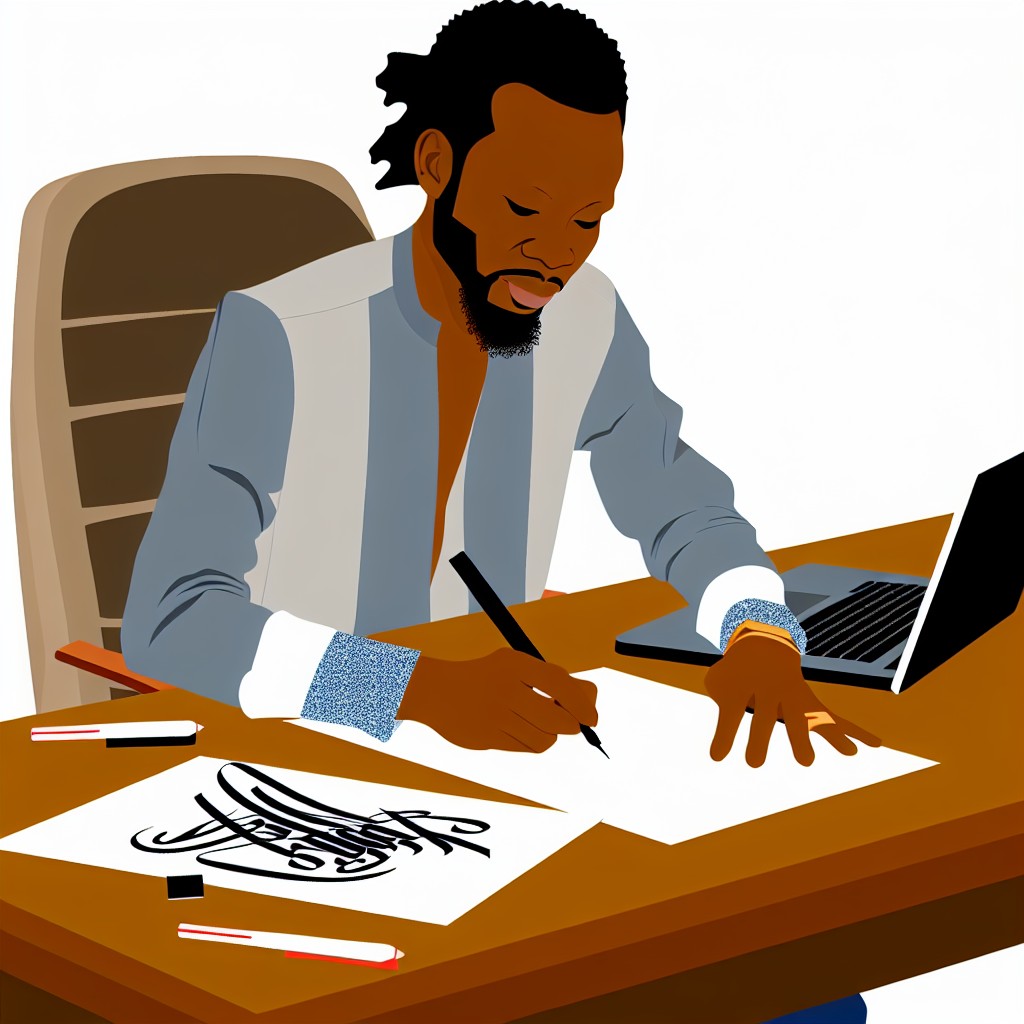
Historical Background of Calligraphy in Nigerian Art Traditions
Origins and Cultural Influences
Calligraphy has deep roots in various Nigerian cultures.
It primarily flourished through Islamic influences in Northern Nigeria.
For centuries, Islamic scholars used Arabic calligraphy in manuscripts and religious texts.
Additionally, the art reflected broader African visual traditions and symbolism.
These traditions combined to shape unique calligraphic expressions in Nigerian art.
Forms of Calligraphy in Traditional Nigerian Art
Indigenous calligraphic styles often include symbolic marks and motifs.
These markings communicate cultural stories, spirituality, and lineage.
Notably, the Nsibidi script among the Ejagham people incorporates iconographic calligraphy.
In northern Hausa and Kanuri communities, Arabic-based scripts influenced decoration work.
Such calligraphy appeared on textiles, architecture, and pottery designs.
Role of Calligraphy in Historical Nigerian Societies
Calligraphy served as a tool for preserving history and knowledge.
It played an essential role in education within Quranic schools, called Tsangaya.
Furthermore, calligraphic decoration denoted status and identity in royal courts.
Collectors and merchants used calligraphic signatures to personalize valuable items.
This tradition helped to establish a strong connection between writing and artistry.
Evolution into Contemporary Art Prints
Modern Nigerian artists draw inspiration from historical calligraphic forms.
They adapt traditional calligraphy to suit printmaking techniques and materials.
Moreover, artists combine calligraphy with abstract and figurative elements.
This fusion revitalizes historic motifs for contemporary audiences.
Consequently, calligraphy remains a vibrant and evolving aspect of Nigerian visual arts.
The Influence of Indigenous Scripts and Symbols on Nigerian Calligraphy
The Foundation of Indigenous Scripts in Nigerian Art
Nigerian artists deeply draw inspiration from their indigenous scripts and symbols.
These elements form a crucial foundation for many calligraphic designs.
For example, Nsibidi symbols from the southeastern region inspire intricate patterns.
Similarly, the Yoruba script and Adinkra symbols influence contemporary typography.
Consequently, artists blend traditional motifs with modern calligraphy.
Significance of Cultural Identity and Heritage
Calligraphy serves as a medium to express cultural identity and pride.
Artists like Hadiza Eze emphasize heritage through traditional writing styles.
Thus, calligraphy revitalizes forgotten scripts for new generations.
Moreover, integrating indigenous symbols creates a unique visual language.
This approach strengthens the connection between art and ethnicity.
Explore Stunning African Digital Art Prints!
Bring the beauty of Nigeria and Africa into your space with high-quality HD digital prints. Browse our collection on Instagram, find what speaks to you, and own a masterpiece today! See something you love? Send us a message on Instagram!
View Collection on InstagramTechniques for Incorporating Indigenous Elements
Artists adapt traditional symbols using various calligraphic techniques.
They often combine brush strokes with carvings or printmaking methods.
Furthermore, these techniques highlight the fluidity and rhythm in scripts.
Creative use of colors and textures adds depth to the calligraphic art.
Halima Balogun employs layered prints to emphasize symbolic meanings.
Impact on Contemporary Nigerian Art Prints
Indigenous calligraphy enriches visual storytelling within art prints.
It allows artists such as Tunde Arinze to connect tradition and modernity.
Consequently, collectors increasingly value works that fuse cultural scripts.
This fusion promotes wider appreciation of Nigeria’s rich artistic legacy.
Ultimately, indigenous scripts remain vibrant inspirations in contemporary calligraphy.
How Contemporary Nigerian Artists Blend Calligraphy with Modern Art Prints
Inspiration from Cultural Heritage
Contemporary Nigerian artists draw deep inspiration from their rich cultural heritage.
They integrate indigenous scripts and traditional calligraphy styles into modern prints.
Many artists revive historical writing forms such as Nsibidi and Ajami in their creations.
Consequently, calligraphy becomes a bridge between past and present artistic expression.
Techniques Used to Integrate Calligraphy
Artists employ diverse techniques to blend calligraphy with printmaking.
Some use hand-drawn calligraphic strokes layered over digital prints.
Others utilize etching and screen printing methods to embed text into their artwork.
Moreover, mixed media combines painted calligraphy with photographic elements.
Symbolism and Meaning in Calligraphic Prints
Calligraphy often carries profound symbolic meaning in Nigerian art.
It communicates messages about identity, faith, and community values.
For example, artist Adetola Ogunlade uses stylized Yoruba proverbs in her prints.
This approach enriches the visual narrative and invites viewer reflection.
Notable Artists Incorporating Calligraphy
Several prominent Nigerian artists skillfully incorporate calligraphy into their prints.
Chike Anoche merges Arabic calligraphy with contemporary African patterns.
Tayo Adekoya’s works showcase elegant Igbo script fused with abstract imagery.
Additionally, Ifeanyi Osunkwo explores Hausa text alongside urban graphic elements.
The Role of Modern Technology
Technology enables artists to experiment freely with calligraphic styles.
Digital tools help refine brushstrokes or create layered text effects.
They also facilitate the reproduction of calligraphic prints for wider audiences.
Thus, technology enhances both creativity and accessibility in this art form.
Explore Stunning African Digital Art Prints!
Bring the beauty of Nigeria and Africa into your space with high-quality HD digital prints. Browse our collection on Instagram, find what speaks to you, and own a masterpiece today! See something you love? Send us a message on Instagram!
View Collection on InstagramInfluence on Nigeria’s Contemporary Art Scene
The fusion of calligraphy and modern prints revitalizes Nigeria’s contemporary art scene.
It attracts global attention while preserving local linguistic traditions.
Art institutions like Lagos Printmakers Gallery promote these hybrid artworks.
As a result, new generations feel empowered to explore their cultural scripts artistically.
Discover More: How African Art Prints Reflect Indigenous Narratives
Techniques and Materials Used by Nigerian Artists to Incorporate Calligraphy
Traditional Calligraphy Methods
Nigerian artists often use traditional pen and ink to create authentic calligraphy strokes.
They employ calamus reeds and brushes made from natural fibers to achieve unique textures.
Additionally, many artisans prefer handmade inks derived from local plants and minerals.
These materials help evoke cultural heritage through their organic qualities.
Integration with Contemporary Art Prints
Artists like Emeka Okoye combine calligraphy with digital printing techniques.
They first sketch calligraphic forms by hand, then digitize them for print reproduction.
This hybrid method allows for scalable distribution of expressive calligraphic art.
Moreover, layering translucent inks creates depth and dimension on print surfaces.
Use of Mixed Media and Textural Elements
Many Nigerian artists incorporate calligraphic marks using acrylic paints and textured canvases.
They use palette knives and sponges to add richness and variety to calligraphic lines.
Furthermore, some printmakers apply foil stamping to highlight specific calligraphic details.
This approach blends tradition with modern visual effects skillfully.
Choice of Surfaces for Calligraphic Prints
High-quality handmade papers are a favorite for calligraphic print production.
Artists also explore surfaces like fabric, wood panels, and ceramic tiles.
Each surface influences the absorbency and final appearance of the calligraphic work.
Consequently, the choice of material impacts both technique and viewer experience deeply.
Tools Enhancing Precision and Style
Fine-tipped brushes and metallic nib pens allow detailed calligraphic flourishes.
Custom-carved stamps are sometimes used to replicate specific calligraphic motifs.
Laser cutting methods assist in creating stencils for repetitive calligraphic patterns.
These tools empower artists to experiment while maintaining calligraphic precision.
Find Out More: The Influence of Nigerian Folk Stories on Art Prints
The Role of Calligraphy in Expressing Cultural Identity and Storytelling
Calligraphy as a Medium of Cultural Expression
Nigerian artists use calligraphy to preserve and showcase their diverse cultural heritage.
Calligraphic art often reflects the rich languages and traditional scripts of Nigeria.
Through elegant strokes, artists convey the history and beliefs of their communities.
Consequently, calligraphy becomes a visual language that speaks beyond words.
Explore Stunning African Digital Art Prints!
Bring the beauty of Nigeria and Africa into your space with high-quality HD digital prints. Browse our collection on Instagram, find what speaks to you, and own a masterpiece today! See something you love? Send us a message on Instagram!
View Collection on InstagramThis medium strengthens cultural pride and promotes awareness among wider audiences.
Storytelling through Artistic Calligraphy
Many Nigerian artists incorporate calligraphy to tell ancestral stories and folklore.
They blend written language with symbolic imagery to create layered narratives.
For example, calligraphic forms can depict proverbs that communicate moral lessons.
Furthermore, these artworks capture oral traditions in a permanent and artistic way.
This art form invites viewers to explore stories that define the Nigerian experience.
Techniques and Influences Behind Calligraphic Art Prints
Artists such as Ifeoluwa Adekunle combine traditional calligraphic patterns with modern printmaking.
They experiment with materials like ink, fabric, and handmade paper for texture.
Moreover, calligraphy often integrates indigenous alphabets with contemporary visual styles.
Collaborations with cultural institutions also enrich this artistic practice.
These techniques result in unique prints that resonate with cultural significance.
Influence of Calligraphy on Contemporary Nigerian Art
Calligraphy empowers artists to express identity amid globalization.
It also bridges generations by connecting modern viewers to ancestral art forms.
Exhibitions in Lagos and Abuja increasingly feature calligraphic prints as central works.
Art collectors in Nigeria and internationally recognize these prints for their authenticity.
Thus, calligraphy remains vital for storytelling and cultural expression today.
See Related Content: The Influence of African Masks on Modern Art Prints
Examples of Prominent Nigerian Artists Known for Calligraphy in Their Prints
Ugochukwu Obiora and His Fusion of Tradition
Ugochukwu Obiora expertly blends Nigerian heritage with modern calligraphic elements.
His prints often feature intricate hand-drawn alphabets inspired by indigenous scripts.
Moreover, he incorporates vibrant colors that highlight the strokes of his calligraphy.
Obiora’s art invites viewers to explore the visual power of written words in culture.
Adanna Ekene’s Contemporary Calligraphic Expressions
Adanna Ekene redefines calligraphy by integrating it with abstract forms in her prints.
She often uses bold lines and sharp angles to create dynamic textual art.
Furthermore, Ekene’s work reflects themes of identity and social discourse through text.
Her approach demonstrates calligraphy’s versatility beyond traditional contexts.
Chika Ajayi’s Afrocentric Calligraphic Motifs
Chika Ajayi focuses on Afrocentric themes using calligraphy to celebrate Nigerian languages.
He incorporates scripts such as Nsibidi and Ajami into his print compositions.
Ajayi combines these scripts with contemporary printmaking techniques for unique visuals.
His art fosters a renewed appreciation for Nigeria’s diverse linguistic heritage.
Olumide Balogun’s Experimental Letterforms
Olumide Balogun pushes calligraphy into experimental realms with his print art.
Explore Stunning African Digital Art Prints!
Bring the beauty of Nigeria and Africa into your space with high-quality HD digital prints. Browse our collection on Instagram, find what speaks to you, and own a masterpiece today! See something you love? Send us a message on Instagram!
View Collection on InstagramHe distorts traditional letterforms to create new visual narratives and patterns.
Balogun’s prints challenge viewers to interpret calligraphy beyond literal reading.
This innovative style expands the boundaries of calligraphy in Nigerian art.
Shared Characteristics of These Artists
- They fuse traditional Nigerian scripts with modern artistic sensibilities.
- Each artist uses calligraphy to convey cultural identity and contemporary themes.
- The artworks often balance legibility with abstract visual impact.
- All of them contribute to the growing recognition of calligraphy in Nigerian print art.
Learn More: The History of Nigerian Textile Art and Printmaking
The Impact of Islamic Calligraphy on Northern Nigerian Art Prints
Historical Influence of Islamic Calligraphy
Islamic calligraphy has deeply influenced northern Nigerian art over centuries.
The spread of Islam introduced Arabic script as a revered artistic element.
Many local artists embraced calligraphy to express spiritual and cultural identities.
As a result, calligraphy became a symbolic and decorative feature in art prints.
Furthermore, it connected northern Nigerian art to broader Islamic artistic traditions.
Techniques and Styles Used by Northern Nigerian Artists
Artists skillfully blend traditional Arabic calligraphy with indigenous motifs.
They use intricate strokes and geometric patterns to enhance visual appeal.
Also, artists employ natural dyes and printing methods to preserve authenticity.
Calligraphic phrases often combine Quranic verses and Hausa proverbs.
Additionally, some artists innovate by incorporating modern typography styles.
Cultural Significance in Contemporary Art Prints
Calligraphy in prints serves as a bridge between faith and daily life.
It conveys messages of unity, peace, and moral values effectively.
Moreover, these prints decorate homes, mosques, and public spaces extensively.
The art form reinforces community identity and pride among northern Nigerians.
Thus, calligraphy remains a living, vibrant expression within the region’s art scene.
Prominent Northern Nigerian Artists Using Calligraphy
Jibril Musa frequently combines calligraphy with textile-inspired backgrounds.
Zainab Ibrahim integrates Arabic scripts with vibrant color palettes in her prints.
Abdullahi Umar is known for minimalist designs focusing on script elegance.
These artists contribute to preserving and evolving calligraphic art styles.
Their works gain recognition locally and in international Islamic art exhibitions.
Challenges and Prospects for Northern Nigerian Calligraphy Art Prints
Some artists face difficulties adapting traditional calligraphy to modern media.
However, digital tools offer new possibilities for innovative print designs.
More training workshops help younger artists learn calligraphic techniques.
Continued collaboration among artisans will sustain this unique art form.
Consequently, northern Nigerian calligraphy art prints have a promising future.
The Fusion of Calligraphy with Other Visual Elements Like Patterns and Motifs
Integration of Cultural Patterns with Calligraphy
Nigerian artists skillfully blend calligraphy with traditional cultural patterns.
Explore Stunning African Digital Art Prints!
Bring the beauty of Nigeria and Africa into your space with high-quality HD digital prints. Browse our collection on Instagram, find what speaks to you, and own a masterpiece today! See something you love? Send us a message on Instagram!
View Collection on InstagramThey often incorporate Adire textile motifs alongside hand-crafted scripts.
These patterns create a rich visual texture that complements the flow of letters.
Consequently, this fusion enhances the artwork’s narrative and cultural depth.
Besides Adire, artists incorporate Uli symbols that convey symbolic meanings.
Therefore, the calligraphy does not stand alone but forms part of a larger visual story.
Use of Geometric Shapes to Frame Calligraphic Art
Geometric motifs frequently frame or highlight calligraphic compositions.
These shapes provide visual rhythm that guides the viewer’s eyes across the print.
From hexagons to concentric circles, geometric elements add modern aesthetic appeal.
Furthermore, combining these shapes with flowing calligraphic strokes creates dynamic contrasts.
Artists like Bolaji Ajiboye use this technique to balance tradition with contemporary style.
Color and Texture Enhancements in Calligraphic Prints
Artists utilize vibrant colors to emphasize both calligraphy and accompanying patterns.
For instance, Chiamaka Okoro’s prints merge bright earth tones with layered calligraphy.
This fusion elevates the tactile quality, giving depth to the visual experience.
Moreover, textured backgrounds often underscore calligraphic scripts for added richness.
These layers attract viewers to explore fine details within the artwork closely.
Symbolism Woven Through Motifs and Script
Calligraphy often carries messages of identity, faith, or history within Nigerian prints.
When combined with symbolic motifs, the artwork’s meaning expands significantly.
For example, artists embed Yoruba proverbs into swirling calligraphic forms.
At the same time, these letters intertwine with decorative patterns representing nature or ancestry.
Thus, the fusion speaks to both aesthetic beauty and cultural storytelling.
Techniques Nigerian Artists Use to Achieve Fusion
Many artists start with hand-drawn calligraphy before overlaying patterned elements.
Others employ digital tools to seamlessly merge calligraphic lines with motifs.
Printmaking methods like linocut and screen printing allow repeated pattern integration.
Additionally, mixed media techniques combine ink, dye, and paint on diverse surfaces.
Through these varied techniques, artists maintain originality and cultural resonance.
Artists Leading the Fusion Movement
Kemi Adeyemi is renowned for merging script with Osun river-inspired patterns.
Her work exemplifies how calligraphy can harmonize with natural motifs effectively.
Meanwhile, Taiwo Olaniran blends Arabic-style calligraphy with Nigerian textile visuals.
These artists continue to innovate while respecting their cultural heritage.
Their prints inspire others to explore calligraphy beyond conventional boundaries.
Explore Stunning African Digital Art Prints!
Bring the beauty of Nigeria and Africa into your space with high-quality HD digital prints. Browse our collection on Instagram, find what speaks to you, and own a masterpiece today! See something you love? Send us a message on Instagram!
View Collection on InstagramThe Significance of Calligraphy in Nigerian Art for Both Local and International Audiences
Cultural Expression and Identity
Calligraphy serves as a powerful tool for cultural expression in Nigerian art.
Artists use intricate scripts to represent their ethnic heritage proudly.
This practice strengthens cultural identity among local communities.
Moreover, calligraphy connects traditional values with contemporary art forms.
Enhancing Visual Storytelling
Calligraphy enriches visual storytelling by adding textual depth to prints.
Artists incorporate proverbs, poetry, and historical references through calligraphic styles.
As a result, viewers engage more deeply with the artwork’s message.
Therefore, the art transcends mere visuals, becoming a narrative experience.
Appealing to International Audiences
Calligraphy attracts international collectors who seek unique cultural artworks.
Its sophisticated style offers a fresh perspective on African art globally.
Furthermore, global exhibitions have spotlighted Nigerian artists using calligraphy prominently.
This exposure helps bridge cultural gaps and promotes mutual appreciation.
Commercial and Educational Value
Locally, calligraphic art prints hold commercial value in galleries and markets.
Artists like Emeka Okeke and Adaobi Onuoha have garnered attention for this style.
Internationally, universities and art institutions study these prints to explore Nigerian heritage.
Consequently, calligraphy plays a vital role in both economy and education.
Preserving Language and Scripts
Calligraphy assists in preserving indigenous Nigerian scripts and languages.
Many prints incorporate Nsibidi and Ajami scripts artistically and respectfully.
This preservation supports linguistic diversity in a rapidly globalizing world.
Thus, calligraphy acts as both art and cultural archive simultaneously.
Challenges in Preserving Calligraphy Through Art Prints
Maintaining Authenticity of Traditional Calligraphy
Preserving the unique brushstrokes of calligraphy poses a significant challenge.
Many Nigerian artists struggle to capture the fluidity of original hand-drawn lines.
Consequently, the printed version can sometimes feel mechanical and lose its soul.
Moreover, ink textures and paper quality affect the reproduction quality.
Artists like Olufemi Adebayo actively seek methods to overcome these hurdles.
Technical Limitations of Printing Methods
Standard printing techniques often cannot replicate subtle variations in calligraphy.
Color accuracy and line sharpness frequently suffer during mass print runs.
As a result, the depth and richness of calligraphic strokes diminish noticeably.
To address this, studios like Lekan Printworks invest in specialized printing technologies.
They use high-resolution scanners and fine art printing to improve results.
Explore Stunning African Digital Art Prints!
Bring the beauty of Nigeria and Africa into your space with high-quality HD digital prints. Browse our collection on Instagram, find what speaks to you, and own a masterpiece today! See something you love? Send us a message on Instagram!
View Collection on InstagramInnovations Enhancing Calligraphy in Art Prints
Incorporation of Digital Tools
More Nigerian artists embrace digital platforms to refine calligraphy artwork.
For example, Yemi Adesina utilizes graphic tablets to preserve brushstroke dynamics.
These tools allow for easy adjustment while maintaining an authentic hand-crafted feel.
Additionally, vectorization helps scale calligraphy without losing detail.
This adaptation bridges traditional artistry with modern production needs seamlessly.
Collaborations Between Artists and Printmakers
Collaborative efforts enhance the quality and authenticity of reproduced calligraphy.
Calligrapher Ifeanyi Okoro works closely with print experts at Ajao Print Studio.
Together, they experiment with various inks, papers, and finishes to retain detail.
This teamwork results in art prints that echo the original calligraphy’s spirit vividly.
Such partnerships strengthen the cultural value and market appeal of calligraphic prints.
Use of Mixed Media Techniques
Some artists integrate calligraphy with other art forms to enrich prints.
For instance, Abiola Tunde combines hand-painted elements with printed calligraphy.
This layering technique adds texture and vibrancy to the final artwork.
Furthermore, it helps differentiate each print as a limited edition masterpiece.
Mixed media approaches keep the tradition alive while encouraging creative exploration.
Additional Resources
Solomon Irein Wangboje: The Printmaker Who Gave Nigerian Art a …
Nigerian Artist Victor Ekpuk Revives Ancient African Graphic Writing …